

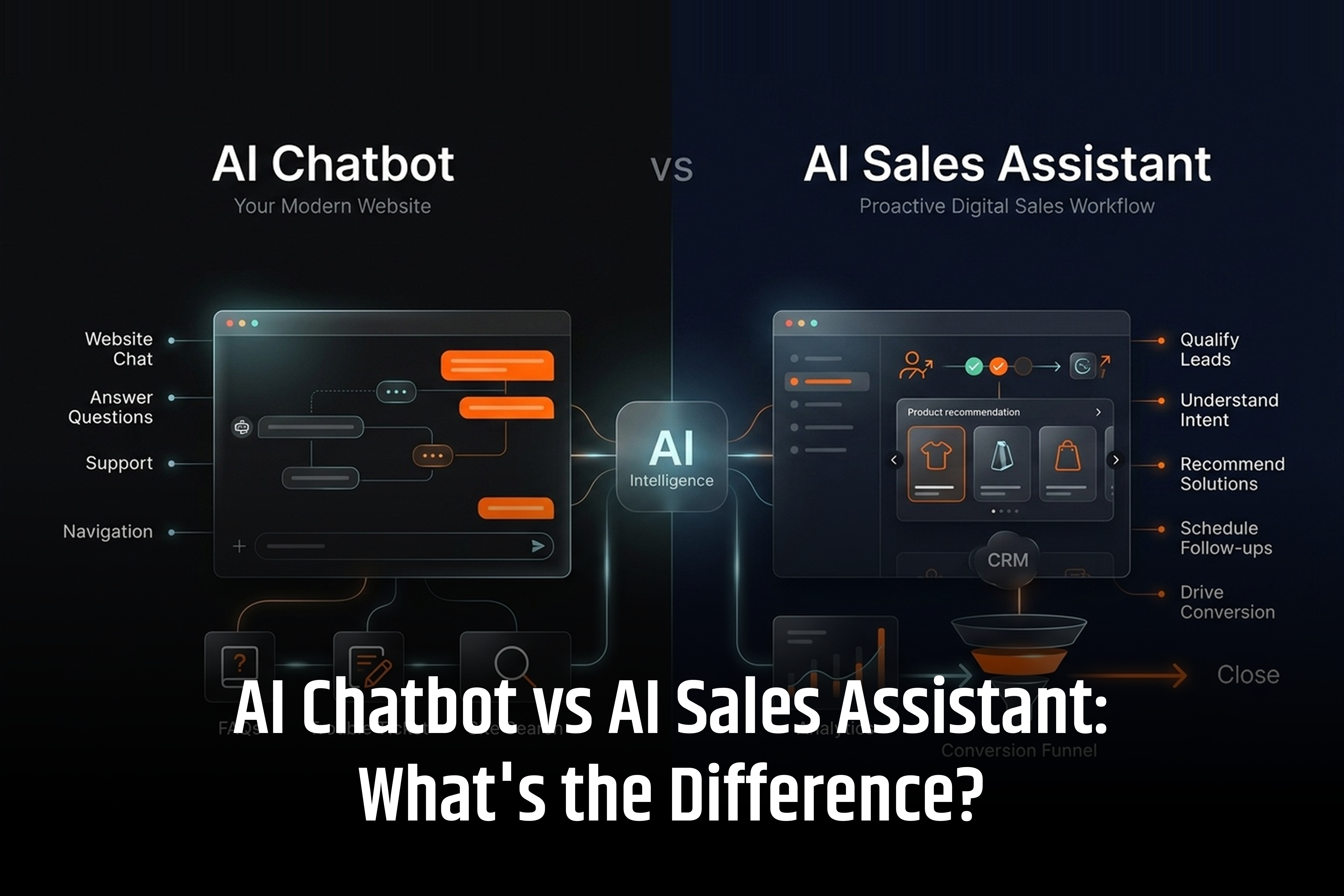

What if your website could do more than answer customer questions? What if it could also identify serious buyers, qualify leads, and help your sales team follow up?
This is where the difference between an AI chatbot and an AI sales assistant becomes important.
An AI chatbot mainly answers questions, provides information, and handles routine customer support. An AI sales assistant is built for sales. It can understand customer needs, qualify leads, recommend products, schedule meetings, and support sales workflows.
In simple terms, an AI chatbot focuses on conversations, while an AI sales assistant focuses on conversations and sales actions.
Modern AI tools can combine both roles. So, the real difference comes down to their purpose, data access, integrations, and ability to take action.
This guide explains the key differences and helps you choose the right option for your business.
AI Chatbot vs AI Sales Assistant: At a Glance
A quick comparison of AI chatbots and AI sales assistants, including their key features, roles, and use cases.
|
Feature |
AI Chatbot |
AI Sales Assistant |
|
Main purpose |
Answer questions and support conversations |
Support and advance the sales process |
|
Primary focus |
Customer communication |
Lead generation, qualification and conversion |
|
Responds to questions |
Yes |
Yes |
|
Natural language |
Often |
Yes |
|
Answers FAQs |
Yes |
Yes |
|
Product information |
Yes |
Yes |
|
Lead capture |
Usually |
Yes |
|
Lead qualification |
Basic to moderate |
Advanced |
|
Intent detection |
Sometimes |
Usually |
|
Personalization |
Limited to advanced, depending on system |
Usually a core capability |
|
CRM integration |
Optional |
Usually important |
|
Customer history |
May be limited |
Often used |
|
Product recommendations |
Sometimes |
Common |
|
Meeting scheduling |
Sometimes |
Common |
|
Follow-up |
Usually limited |
Often supported |
|
Sales workflow automation |
Limited |
Stronger |
|
Multi-step actions |
Limited |
More capable |
|
Human handoff |
Yes |
Yes |
|
Best for |
Support, FAQs, basic interactions |
Sales, qualification, recommendations and revenue workflows |
The table is a general framework, not a strict technical classification. Modern products can combine chatbot, assistant, copilot and agent capabilities in one system.
In 2026, the label used by a vendor is less important than the system's actual permissions, integrations, memory, tools and ability to execute actions.
What is an AI Chatbot?
An AI chatbot is software that uses AI and natural language processing (NLP) to understand questions and provide human-like responses.
Unlike traditional rule-based chatbots, modern AI chatbots can understand context and generate relevant answers using large language models (LLMs).
Common AI Chatbot Uses
AI chatbots can:
- Answer FAQs
- Provide customer support
- Share product information
- Capture basic leads
- Help users navigate a website
- Handle common requests
- Provide 24/7 support
- Route customers to the right team
In simple words: An AI chatbot helps businesses automate conversations and answer customer questions without requiring a human for every interaction.
What is an AI Sales Assistant?
An AI sales assistant is an AI-powered tool that helps businesses manage sales conversations and qualify potential customers.
It can do more than answer questions. An AI sales assistant can:
- Understand buyer intent
- Ask qualifying questions
- Identify customer needs
- Recommend relevant products or services
- Capture and qualify leads
- Use CRM data
- Personalize conversations
- Schedule meetings
- Route qualified leads to sales teams
- Support follow-ups
- Update customer records
For example, instead of only answering "What plans do you offer?", it can ask about the customer's needs and recommend the most suitable plan.
In simple words: An AI sales assistant combines conversation with sales tasks to help businesses identify, qualify, and convert potential customers.
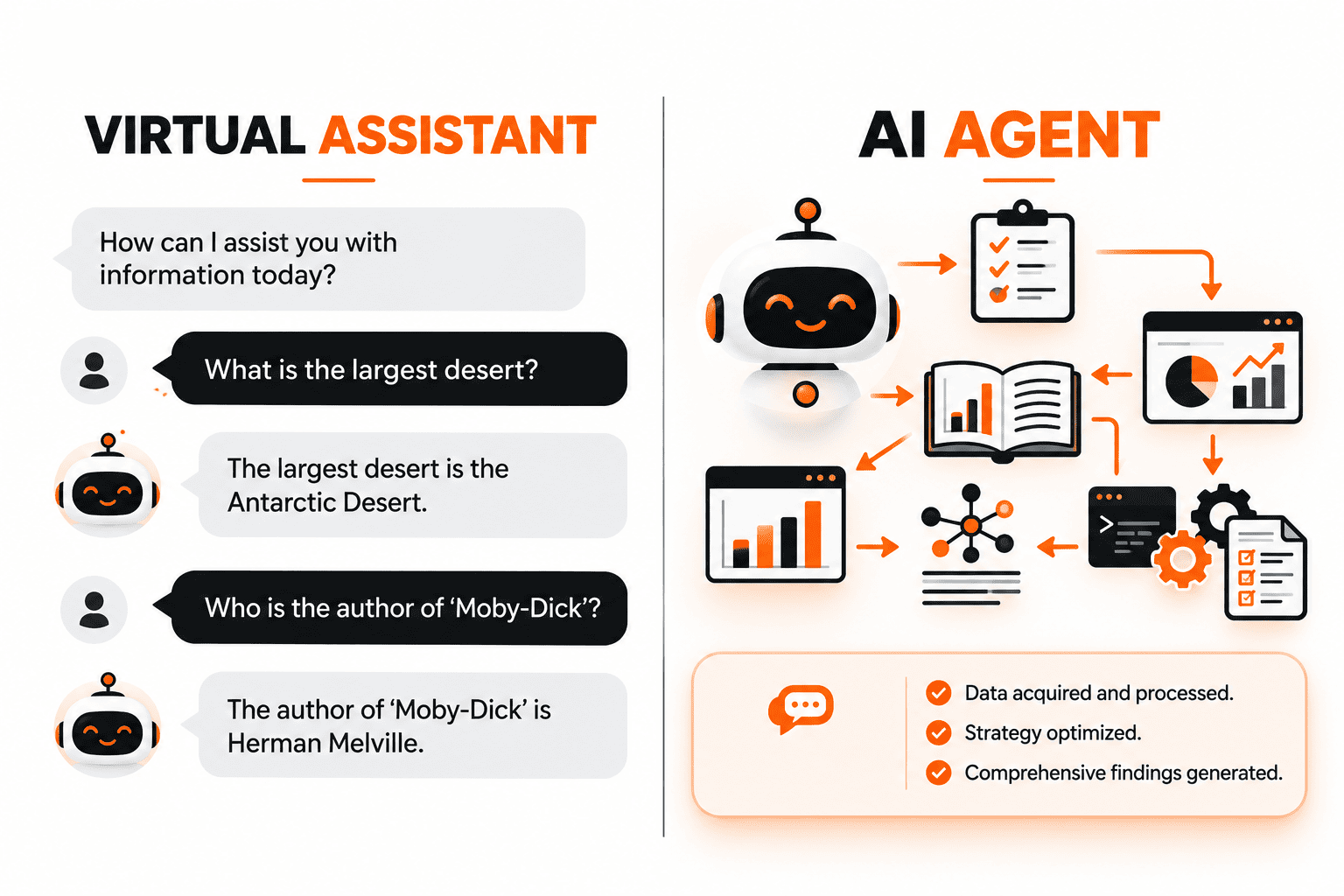
Differences Between an AI Chatbot and AI Sales Assistant
A quick comparison of key differences between AI chatbots and AI sales assistants, including their roles, features, and sales capabilities.
1. Purpose
- AI chatbot: Handles questions and customer conversations.
- AI sales assistant: Supports lead generation, qualification, and sales activities.
2. Lead Qualification
- AI chatbot: Usually collects basic details such as name and email.
- AI sales assistant: Asks qualifying questions and evaluates lead fit.
Lead capture = collecting information.
Lead qualification = determining whether a lead is a good fit.
3. Customer Intent
- AI chatbot: Responds to the user's question.
- AI sales assistant: Looks for buying signals, needs, urgency, and interest in the product.
For example, "What are your opening hours?" shows informational intent.
"Can I get a demo for my 50-person team?" shows stronger buying intent.
4. Personalization
- AI chatbot: Often provides standard responses.
- AI sales assistant: Can use customer data, conversation history, CRM information, and stated needs to personalize responses.
5. CRM Integration
- AI chatbot: CRM integration may not be necessary.
- AI sales assistant: Often connects with tools such as Salesforce, HubSpot, Zoho CRM, and Pipedrive.
This lets lead details and conversation data flow into the sales workflow.
6. Product Recommendations
- AI chatbot: Provides product information.
- AI sales assistant: Can recommend a product or plan based on customer needs and approved business data.
7. Ability to Take Action
- AI chatbot: Usually provides information or instructions.
- AI sales assistant: Can use connected tools to perform actions, such as booking a meeting, when permissions allow.
8. Follow-Up
- AI chatbot: Usually waits for the customer to start a conversation.
- AI sales assistant: Can support follow-up workflows, create tasks, and send approved follow-up messages.
9. Memory and Context
- AI chatbot: May remember context within the current conversation.
- AI sales assistant: Can also use CRM records, customer history, previous conversations, and other business data, depending on the system.
What Can an AI Chatbot Do for Sales?
An AI chatbot can support sales by:
- Answering product and pricing questions
- Capturing lead details
- Asking basic qualification questions
- Routing leads to the right team
- Booking meetings
- Answering customer questions
In short, an AI chatbot handles basic sales conversations and lead capture.
What Can an AI Sales Assistant Do?
An AI sales assistant supports more advanced sales tasks, such as:
- Qualifying leads
- Understanding buyer needs
- Recommending products
- Handling objections
- Scheduling meetings
- Updating CRM records
- Summarizing conversations
- Supporting follow-ups
- Researching prospects
- Managing sales workflows
In short, an AI sales assistant helps move prospects through the sales process.
AI Chatbot vs AI Sales Assistant: Example
A visitor asks, "How much does your software cost?"
AI chatbot: Provides pricing information.
AI sales assistant: Asks about the visitor's needs, recommends a suitable plan, qualifies the lead, and can schedule a demo.
The key difference:
AI chatbot → Answers questions.
AI sales assistant → Supports the sales process.
Human Handoff Still Important
AI does not replace human sales representatives. The best approach is often:
AI handles routine tasks → Humans handle complex decisions.
AI can handle:
- Initial questions
- Lead qualification
- Product information
- Scheduling
- Conversation summaries
Humans can handle:
- Complex negotiations
- Enterprise deals
- Sensitive situations
- Custom requirements
- Contracts and high-value decisions
This approach is called human-in-the-loop, where humans review or take over when needed.
Benefits of an AI Chatbot
- Faster responses: Answers customer questions instantly.
- 24/7 support: Works outside business hours.
- Less repetitive work: Handles common questions automatically.
- Scalable support: Manages multiple conversations at once.
- Lead capture: Collects visitor and contact details.
- Consistent answers: Provides information from approved knowledge sources.
- Easy integration: Can work across websites, apps, and messaging channels.
Benefits of an AI Sales Assistant
- Better lead qualification: Identifies leads that match your criteria.
- Personalized conversations: Uses customer needs and context.
- Faster lead response: Engages prospects without waiting for a salesperson.
- Sales automation: Connects conversations with CRM and sales workflows.
- Product recommendations: Suggests relevant products or services.
- Better handoffs: Gives sales teams conversation summaries and key details.
- Sales team support: Helps with research, preparation, follow-ups, and summaries.
AI Chatbot vs AI Sales Assistant: What is Changing in 2026?
In 2026, AI is moving beyond simple conversations. AI systems can now complete tasks, use business data, and automate workflows.
AI chatbots mainly answer questions and provide support. AI sales assistants can also qualify leads, update CRM records, schedule meetings, and support sales tasks.
The main shift is from AI that responds to AI that can take action.
Modern systems can combine:
- AI chat
- LLMs
- Knowledge bases
- CRM integration
- Sales automation
- AI agents
- Human handoff
So, the key question is not just whether a tool is a chatbot or sales assistant. Ask what it can understand, what data it can access, and what actions it can take.
Conclusion: AI Chatbot vs AI Sales Assistant
AI chatbots and AI sales assistants have different roles. An AI chatbot answers questions and handles basic support. An AI sales assistant does more. It can qualify leads, understand buyer intent, recommend products, and support sales teams.
The right choice depends on your needs. A chatbot works well for FAQs and customer support. An AI sales assistant is better for lead generation and sales automation.
Want to turn more website visitors into qualified leads?
Try WOWagent to automate lead engagement, lead qualification, and sales conversations with AI.
Frequently Asked Questions
Featured Reads
Latest Insights & Ideas
AI Sales Assistant
AI Sales Assistants for SaaS Startups: Guide 2026
Struggling to manage leads, follow-ups, and sales tasks with a small team? AI sales ass...
Read More
Website Monitoring
AI-Powered Search vs. Website Navigation: What Is the Difference?
AI-powered search helps users find answers quickly, while website navigation helps user...
Read More
SEO Intelligence
How AI Website Agents Can Help Improve SEO and User Experience
What if your website could improve SEO, guide visitors, answer questions, and capture l...
Read More